GPU Mart Industry Research · June 2026

GPU Hosting Usage Report 2026:
Enterprise Workloads & Infrastructure Analysis

This report examines how enterprises across AI development, media production, 3D visualization, cybersecurity, healthcare AI, and industrial vision are selecting, deploying, and scaling GPU infrastructure — and what workload patterns distinguish each segment.

200 GPU Hosting Customers Sampled · 197 Unique Domains 18 Industry Segments Published June 2026 GPU Mart Research Team
Data scope: Based on 200 enterprise GPU Hosting customers across 18 industry segments (June 2026). Authorized customer cases are published with explicit written permission; all other workload observations are fully anonymized — no company names or domain identifiers disclosed. GPU Mart is the GPU hosting brand of Database Mart; the customer data and service insights referenced in this report are drawn from Database Mart's customer platform, which powers GPU Mart services.
Section 1 · Key Findings

Six Findings from 200 Sampled Enterprise GPU Customers

The following observations synthesize quantitative order data with workload intelligence from authorized customer interviews and anonymized technical support records.

Finding 01

AI inference, not training, is now the dominant enterprise GPU workload. The largest scenario cluster in the sample — 21 records across AI application development — consists almost entirely of persistent inference deployments: self-hosted LLM APIs, agentic AI pipelines, digital human backends, and multimodal decision engines. Training workloads, by contrast, are statistically marginal in this dataset.

Finding 02

58% of GPU orders originate outside the technology sector. Media & entertainment (10.1%), financial services (5.8%), real estate & architecture (5.3%), manufacturing (4.3%), healthcare (2.9%), and 12 additional industry segments all contribute observable GPU order volume. GPU Hosting is no longer a technology-only procurement category.

Finding 03

Over 70% of sampled customers are at Professional or Enterprise tier. Professional-tier customers account for 23.0% and Enterprise for 27.5% — together representing 50.5% of the sample. Adding Advanced (19.5%), a full 70% of customers operate at mid-to-high tier. Entry-level (Lite/Express) accounts for just 12.5% of the sample, reflecting a market where GPU Hosting is primarily a production infrastructure decision, not an experimental one.

Finding 04

Data sovereignty is a decisive procurement factor — not a secondary concern. Across healthcare AI, legal document analysis, cybersecurity, quantitative trading, and agentic AI cases, the requirement that sensitive data never leave a physically dedicated server is the single most-cited reason for choosing GPU Hosting over public cloud APIs or serverless inference endpoints.

Finding 05

Multi-service GPU stacking is now the norm, not the exception. The most technically sophisticated workloads in the sample run LLM inference, TTS synthesis, vector retrieval, video encoding, and image generation simultaneously on a single GPU. This pattern fundamentally changes the VRAM planning discipline: total allocation across concurrent services — not peak single-service demand — governs GPU selection.

Finding 06

Always-on reliability separates dedicated GPU Hosting from spot and preemptible instances. Multiple customers in the sample migrated from cloud spot GPU providers specifically because in-flight inference workloads were terminated without warning. For production AI systems — particularly agentic pipelines, real-time audio/video processing, and 24/7 inference APIs — physical dedicated infrastructure is the only architecture that eliminates this failure mode.

Sources: GPU Mart enterprise GPU order dataset (n=200, June 2026); IDC Worldwide Quarterly Server Tracker Q3/Q4 2025; Stanford HAI AI Index 2026; authorized customer interviews (6 cases, written consent on file).

Section 2 · Data Foundation

Sample Scope & Methodology

This report is based on a sample of 200 GPU Hosting customers drawn from GPU Mart's enterprise customer records. The 200 records represent a cross-section of GPU Hosting customers across 18 industry segments.

MetricValueNotes
GPU customer sample (deduplicated)200All records are GPU product customers
Unique company domains197Separate business units sharing a domain root are treated as independent records
Scenario-classified orders~100~50% of sample; sufficient industry + business context available
Unclassified orders~100Insufficient business context for confident scenario placement
Industries represented18Including sub-segments across 120+ L2 categories
Dataset cutoffJune 2026
Sample note: The 200-record sample represents GPU product customers with identifiable company domains. Customers using private email addresses (Gmail, Outlook, etc.) without a matching company domain are excluded from this dataset, which means consumer-facing or individual developer GPU usage is not represented. The sample skews toward identifiable business entities, making it more representative of enterprise and professional GPU Hosting demand than of total GPU Mart customer volume.
Industry Distribution — 200 GPU Customer Sample
Tech & Software
85 · 42.5%
Business & Prof. Services
22 · 11.0%
Media & Entertainment
20 · 10.0%
Finance & Insurance
12 · 6.0%
Real Estate & Architecture
11 · 5.5%
Manufacturing & Industrial
9 · 4.5%
E-Commerce & Retail
6 · 3.0%
Education & Training
6 · 3.0%
Healthcare & Life Sciences
6 · 3.0%
Transport & Logistics
5 · 2.5%
Telecoms & Communications
5 · 2.5%
Govt / Non-profit / Agriculture / Energy / Travel / Other
13 · 6.5%
Section 3 · Customer Profile

Enterprise GPU Customer Quantitative Profile

The following tables and charts characterize the GPU order population across three dimensions: product tier, GPU model frequency, and customer engagement depth.

3.1 Product Tier Distribution

Tier classification assigns each of the 200 sampled customers to their highest active tier. The distribution shows a pronounced concentration at Professional and Enterprise levels — together accounting for over 50% of the sample. Entry-level tiers (Lite/Express) represent just 12.5% of sampled customers.

Tier (highest active)CustomersShareTypical Use
Lite52.5%Lightweight remote desktop GPU, minimal encoding
Express2010.0%Entry-level GPU, NVENC encoding, low-load inference
Basic3517.5%7B model inference, basic AI functionality, entry dedicated GPU
Advanced3919.5%Mid-range dedicated GPU, production LLM inference, 3D rendering
Professional4623.0%High-end GPU VPS, multi-service stacking, specialized AI workloads
Enterprise5527.5%Enterprise dedicated server, Multi-GPU, 70B+ model hosting
Analysis: The Enterprise tier (27.5%) and Professional tier (23.0%) together represent over half the sampled customer population — a striking signal for what began as entry-level GPU Hosting infrastructure. This top-heavy distribution reflects a customer base that has graduated from experimentation to production: Enterprise customers are typically running 70B+ models, Multi-GPU configurations, or high-density AI workloads that require the largest available VRAM allocations. The 19.5% Advanced tier represents the active growth segment — customers who have validated their GPU workloads and are scaling toward Professional or Enterprise configurations.
Customer Engagement Depth (Package Record Count)
1 record
65 · 32.5%
2–3 records
53 · 26.5%
4–10 records
44 · 22.0%
11–40 records
13 · 6.5%
40+ records
8 · 4.0%

Note: The 40+ record tier includes customers with 40, 58, 75, 137, and 354 package records — multi-year GPU Hosting relationships with complex multi-tier product portfolios. 67.5% of sampled customers have 2 or more product records, indicating active infrastructure management rather than one-time purchases.

3.2 GPU Model Frequency

GPU model counts reflect the number of customer accounts where each model appears as an active product. Customers with multiple GPU models are counted once per model.

GPU ModelAppearancesSegmentVRAM
RTX A4000 (VPS + Dedicated)53Ampere · Both16 GB GDDR6
P600 (VPS + Dedicated)28Pascal · Both2 GB GDDR5
RTX A500023Ampere · Dedicated24 GB GDDR6
RTX 409020Ada · Dedicated24 GB GDDR6X
RTX 5090 (VPS + Dedicated)19Blackwell · Both32 GB GDDR7
P1000 / P620 (Express)25Pascal · Dedicated4 GB GDDR5
RTX Pro 6000 GPU VPS18Blackwell · VPS96 GB GDDR7
RTX 5060 (VPS + Dedicated)16Blackwell · Both8 GB GDDR7
RTX A600016Ampere · Dedicated48 GB GDDR6
K80 (Legacy)16Kepler · Dedicated12 GB GDDR5
V10014Volta · Dedicated16/32 GB HBM2
RTX Pro 4000 GPU VPS11Blackwell · VPS24 GB GDDR7
A100 (40G / 80G)11Ampere · Dedicated40–80 GB HBM2e
A4010Ampere · Dedicated48 GB GDDR6
Analysis — RTX A4000 dominance: With 53 combined appearances across GPU VPS and Advanced Dedicated Server configurations, the RTX A4000 is the most frequently selected GPU in the sample — more than double the next model. This reflects its role as the enterprise "validation threshold": 16GB VRAM is sufficient for 7B–14B model inference at FP16, with headroom for concurrent lightweight services. At $129–$209/month, it represents the lowest-cost entry point for production-grade dedicated GPU infrastructure.

Blackwell adoption signal: The Blackwell architecture is now present across four distinct product lines in the sample: RTX 5090 (19 appearances), RTX Pro 6000 GPU VPS (18), RTX 5060 (16), and RTX Pro 4000 GPU VPS (11). The RTX Pro 6000 GPU VPS at 96GB GDDR7 ranking in the top tier despite being a premium product signals that a meaningful segment of enterprise customers have already migrated to Blackwell specifically for 70B+ model hosting and multi-service GPU stacking where 96GB VRAM is the minimum viable configuration.

Pascal persistence (P1000, P600): The continued presence of Pascal-generation GPUs (P600 combined: 28 appearances; P1000/P620 combined: 25 appearances) reflects use cases that do not require modern AI compute: 24/7 NVENC video encoding and lightweight remote GPU workstations where VRAM above 4GB is unnecessary. Notably, the legacy K80 (16 appearances) and V100 (14 appearances) also appear significantly — suggesting a long tail of customers running older GPU infrastructure for non-inference workloads or cost-optimized batch processing.
Section 4 · Industry Scenario Analysis

GPU Workload Patterns Across 18 Industry Segments · 200-Customer Sample

This section organizes the 18 L1 industry segments in the dataset into 8 thematic scenario groupings based on shared GPU workload characteristics. The groupings reflect workload logic, not formal industry taxonomy — for example, financial services and legal tech share a "data-sovereign AI inference" pattern despite being distinct industry categories, while media & entertainment spans three distinct GPU workload types (encoding, audio AI, interactive content) within a single industry label. Where multiple L1 segments share a workload pattern, they are analyzed together; where a single L1 segment contains meaningfully distinct workloads, it is analyzed in sub-sections.

About this sample: All 200 records are GPU product customers. Some accounts contain GPU products alongside other services (VPS, dedicated servers, domain registrations, SSL certificates). The 200-record figure reflects the deduplicated GPU customer sample used throughout this report. Where the analysis refers to "GPU orders," this means GPU product line items across the 200 sampled customer accounts.
1
AI Application Development, LLM Inference & Agentic AI
21 confirmed orders · 10.1% of dataset · Tech & Software sector

This is the single largest classifiable scenario cluster in the sample, concentrated within the "AI development & automation platforms" L2 segment (9 orders) and "AI tools & automation" (3 orders). The defining characteristic is persistent, always-on inference — not batch training. Customers in this segment run LLM APIs as core business infrastructure: every customer interaction, autonomous agent action, or AI-driven decision traverses the GPU continuously, 24/7.

Observed workload patterns (from authorized cases and anonymized technical records):

  • Self-hosted LLM serving via Ollama, vLLM, and llama.cpp, typically running 2–5 models simultaneously in production (e.g., a code model, a general chat model, and a domain-specialized model on one server)
  • Agentic AI pipelines where multiple LLM-powered agents orchestrate business workflows autonomously — scheduling, research, content generation, and decision routing — without human intervention between cycles
  • Digital human / intelligent voice assistant backends: a single 48GB GPU VPS simultaneously running a 35B-class LLM (28GB VRAM), a TTS synthesis engine (CosyVoice 3, ~11GB), and a persistent conversation memory store — pushing total VRAM allocation to near-capacity
  • Multimodal AI platforms integrating NLP, vision language models (VLMs), image generation (ComfyUI / Flux), and content classifiers on a single card, with VRAM demand approaching 48GB even at INT4/FP8 quantization
  • Legal AI document analysis: local LLM (70B class, quantized) processing legal documents for clause extraction, risk flagging, and contract summarization — deployed as a microservice behind FastAPI, with no data transiting external infrastructure

GPU configuration path observed: RTX A4000 (16GB, entry) → RTX Pro 4000 GPU VPS (24GB GDDR7, production) → RTX A6000 (48GB, multi-user concurrent) → RTX Pro 6000 GPU VPS (96GB GDDR7, 70B+ / multi-model) → A100-80G (high-concurrency fine-tuning)

Sector conclusion: The AI inference scenario is defined less by GPU model than by VRAM allocation discipline. The transition from single-service to multi-service GPU stacking is the key architectural inflection point — once enterprises begin running more than one AI service on a single card (LLM + TTS, or LLM + vector search + image generation), the minimum viable VRAM requirement roughly doubles, and the selection logic shifts from "what model can I run" to "what combination of services can I sustain simultaneously at production quality."
agentic AIprivate AIself-hosted AIAI deployment stackOllamavLLMllama.cppmulti-model stacking
2
Media & Entertainment: Video Encoding, Streaming & Audio AI
21 records total sector · Film/TV/Streaming: 4 orders · Music & Audio: 4 orders · Gaming & Interactive: 4 orders · Portals & Media: 3 orders

The Media & Entertainment sector (21 records, 10.1%) presents the most internally heterogeneous GPU workload profile in the dataset. Three distinct GPU use cases coexist within the same industry classification: real-time NVENC video encoding, AI audio processing, and interactive content AI. Each has materially different GPU selection criteria.

Real-time video encoding (Film/TV/Streaming, 4 orders): The primary driver is NVENC/NVDEC hardware encoder availability and uptime — not compute throughput. Customers in this sub-segment use Pascal-generation GPUs (P1000, P600) that would be considered obsolete for AI inference but remain fully capable for H.264/H.265 real-time encoding. The ZeroOne Beats authorized case (below) exemplifies this: a P1000 runs 24/7 NVENC encoding at zero thermal throttle, while CPU handles all other workloads simultaneously.

AI audio processing (Music & Audio, 4 orders; including AI audio tools): This is the technically most demanding sub-segment in the sector. One anonymized customer ran MelBandRoformer — a SOTA audio separation Transformer — on an RTX 5090, sustaining 24.5GB VRAM usage, 488W power draw, and 81% GPU utilization for a Spanish podcast audio cleaning pipeline. Another customer deployed vocal separation tools (human voice isolation / accompaniment extraction) processing user-uploaded audio on demand. GPU selection here is compute-intensity-driven, not VRAM-constrained: high TFLOPS and thermal stability matter more than memory capacity.

Gaming & interactive content (4 orders): Customers include eSports analytics platforms, interactive entertainment services, and sports data AI. GPU workloads span real-time game content encoding, AI-driven sports statistics inference, and interactive recommendation engines.

Sector conclusion: The Media & Entertainment sector illustrates a critical observation: industry segment alone is an insufficient predictor of GPU requirements. Within a single 21-record sector, optimal GPU selections range from a $49/month P1000 (for 24/7 NVENC encoding) to an $399/month RTX 5090 GPU VPS (for sustained Transformer audio processing at 488W). Workload characterization — not industry classification — must drive GPU selection.
AI computeAI workloadNVENC encodingMelBandRoformerRTX 5090audio AI pipeline
3
Real Estate, Architecture & 3D Design
11 records total sector · Architecture engineering: 4 orders · Architectural AI design tools: 2 orders · Interior design & space planning: 1 order · Construction site visualization: 1 order · Other real estate: 3 orders

The real estate and architecture sector (11 records) splits into two GPU deployment modes with distinct technical profiles: remote GPU workstations for interactive design, and batch rendering / AI-assisted visualization pipelines.

Remote GPU workstations: Architects and interior designers connect to GPU servers via RDP to run 3ds Max, SketchUp, Rhino, AutoCAD, and Revit at full quality, without a local high-performance workstation. GPU selection here prioritizes certified professional driver support (NVIDIA Studio or Quadro-class drivers) and responsive viewport performance over raw TFLOPS. RTX Pro 4000 GPU VPS (24GB GDDR7) covers the majority of professional 3D application needs.

Batch architectural rendering and AI design: One anonymized 3D interior design SaaS platform in the sample — the deepest customer engagement profile in the entire dataset across this sector — has scaled from Lite GPU Server (GT710, entry-level viewport rendering) to Enterprise Multi-GPU configurations including 3×RTX A6000 (144GB combined VRAM) and 3×RTX A5000 (72GB). This upgrade trajectory, driven by growing user demand for rendered output volume and AI-assisted floor plan generation, is the clearest multi-year GPU infrastructure scaling case in the dataset.

The construction-tech sub-segment (construction site data & drone surveying: 2 orders; architectural AI & construction management software: 1 order) represents a distinct workload: drone survey imagery processed through computer vision models for construction progress monitoring, site safety analysis, and volume calculation. GPU workloads are batch-oriented rather than interactive.

Sector conclusion: The architecture and real estate sector demonstrates GPU infrastructure as a long-term asset — not a trial. The 3D design SaaS customer scaling from GT710 to 3×RTX A6000 over multiple years represents one of the clearest cases of GPU Hosting enabling infrastructure growth that would have been cost-prohibitive to replicate with owned hardware at each stage.
gpu infrastructure3D renderingremote GPU workstationbatch renderingMulti-GPUconstruction AI
4
Financial Services, Fintech & Quantitative Trading
12 records total sector · Investment & asset management: 2 orders · Lending & mortgage: 2 orders · Insurance: 4 orders · Banking: 1 order · Forex & online trading: 1 order · Crypto & digital assets: 1 order · Trading & investment education: 1 order

Financial services (12 records, 5.8%) is the sector where GPU Hosting's data sovereignty advantage is most operationally critical. Proprietary trading signals, client portfolio data, and risk models cannot be processed on shared cloud infrastructure — not for regulatory reasons alone, but because the competitive value of the data is destroyed the moment it transits a third-party system.

Quantitative trading AI (observed anonymized case): An RTX A6000 (48GB) dedicated server runs a complete GPU-accelerated trading stack: time-series data ingestion from a database, Transformer and reinforcement learning model inference for price prediction and signal generation, local LLM (FinBERT-class) for fundamental analysis from news and filings, and a position-size risk calculator. GPU-local inference reduces decision latency 70–90% versus equivalent remote API calls — a decisive margin in algorithmic trading contexts.

Insurance and compliance AI: Multiple insurance-sector customers use GPU servers for AI-assisted claims processing, policy document analysis, and compliance data extraction. These workloads benefit from dedicated GPU inference for the same reason as trading: sensitive client data cannot be sent to public AI APIs under most insurance regulatory frameworks.

Crypto and digital assets: One customer in this sub-segment (NFT marketplace / digital collectibles trading) uses GPU infrastructure for marketplace operations and content rendering — a non-inference GPU workload reflecting the diversity of financial services GPU demand.

Sector conclusion: Financial services represents the clearest intersection of performance requirements and compliance constraints. GPU Hosting's physical data isolation is not merely a privacy feature in this sector — it is a precondition for the workload being legally and competitively feasible. The quantitative trading case illustrates that for latency-sensitive AI inference, the 70–90% latency reduction from local vs. remote GPU inference is a material business advantage, not an incremental optimization.
AI inference infrastructureenterprise AIFinBERTquantitative tradingdata sovereigntylow-latency inference
5
Business & Professional Services: AI-Augmented Operations
22 records total sector · Advertising & digital marketing: 8 orders · Business consulting: 2 orders · Legal services: 2 orders · HR & outsourcing: 2 orders · Virtual assistant services: 1 order · Other: 7 orders

Business and professional services (22 records, 10.6%) is the second-largest sector in the dataset and the broadest in workload diversity. The dominant sub-segment — advertising and digital marketing (8 orders) — drives GPU demand through AI content generation pipelines: image generation (ComfyUI, Stable Diffusion, Flux), video content automation, and AI copywriting at scale.

Legal services (2 orders) use GPU servers for local LLM deployment processing client documents — contracts, filings, case research — with no data sent to external APIs. One customer in the legal sub-segment runs a law firm billing, accounting, and case management software stack that integrates a local AI model for document intelligence.

The HR and virtual assistant sub-segments (3 orders combined) reflect emerging AI augmentation in traditionally human-intensive professional workflows: AI-assisted resume screening, employee benefits platform AI, and virtual assistant AI that replaces or supplements human agents for routine client interactions.

The CRM and sales automation sub-segment (1 order) uses GPU-accelerated AI for sales signal detection, conversation intelligence, and deal-scoring models that process CRM data continuously — a lighter-weight but persistent AI inference pattern.

Sector conclusion: Professional services is the sector where GPU adoption is least obvious from the outside — these organizations are not "AI companies," but they are deploying AI as operational infrastructure at a rate that mirrors tech-sector patterns from 2–3 years earlier. The advertising and digital marketing sub-segment's 8 orders (the largest L2 cluster outside pure AI development) suggests that AI content production at scale has already crossed the threshold from cloud API consumption to private GPU infrastructure.
AI hostingAI production environmentComfyUIFluxlegal AIAI content generation
6
Manufacturing, Industrial & Engineering
9 records total sector · Industrial equipment & machinery: 2 orders · Industrial automation & control: 1 order · Machine vision: 1 order · Construction tech & engineering visualization: 1 order · Other: 4 orders

Manufacturing and industrial (9 records, 4.3%) is the sector where GPU Hosting is furthest from its AI-native origins — and where the use cases are perhaps the most technically specialized. The connecting thread is computer vision applied to physical-world data: cameras, sensors, and drones generating continuous image and video streams that require GPU-accelerated processing for real-time analysis.

Industrial machine vision and quality control: GPU servers process camera feeds from production lines for defect detection, dimensional measurement, and assembly verification. The workload is effectively continuous inference — models running against a stream of incoming frames without interruption.

3D point cloud processing (anonymized case): An RTX Pro 5000 GPU VPS (48GB) runs 3D point cloud matching algorithms, generating large-scale CSV result sets for industrial quality inspection or manufacturing precision verification. The high VRAM allocation is driven not by model size but by the memory requirements of large-scale 3D geometry computation.

Industrial automation: The industrial automation and control sub-segment (industrial automation & control and IoT / asset tracking technology platforms) represents edge AI integration — GPU servers in the cloud processing data from distributed sensors and control systems, with the GPU acting as a central inference hub for distributed industrial data.

Sector conclusion: Manufacturing and industrial represents the frontier of GPU Hosting adoption — a sector not yet fully converted, but where the technical case is unambiguous. Industrial vision workloads are non-negotiably persistent (production lines do not pause), physically isolated (factory data cannot leave the facility perimeter), and increasingly GPU-dependent as model complexity grows. The 9-record signal in this dataset likely understates the addressable market.
AI serverindustrial visionmachine visionpoint cloudedge AIcomputer vision
7
Healthcare, Life Sciences & Medical AI
6 records total sector · Medical operations & revenue cycle: 2 orders · Life sciences research: 1 order · Medical compliance data: 1 order · Healthcare services: 1 order · Home care & health: 1 order

Healthcare and life sciences (6 records, 2.9%) is the dataset's clearest example of regulatory-driven GPU infrastructure decisions. The sector's presence in the sample is modest in volume but disproportionately significant in technical complexity and compliance implications.

Multimodal medical AI (anonymized case): An RTX A6000 (48GB) dedicated server runs an AI system that perceives the clinical environment through camera and microphone, auto-generates OPD (outpatient department) records, and exposes an API for frontend EMR integration. The AI is evolving from text-only NLP toward multimodal understanding (combining visual and auditory clinical context). NVIDIA Jetson hardware handles on-site sensing; the cloud GPU handles inference. Medical records cannot transit third-party infrastructure under virtually any jurisdiction — dedicated GPU Hosting is not a cost-optimization choice here, it is a compliance requirement.

Medical compliance data tools (anonymized): One customer in the DEA/NPI license verification and compliance data category uses GPU-accelerated processing for healthcare regulatory data at scale — a less AI-intensive but computationally demanding workload pattern.

Life sciences research: The single life sciences research record represents academic or applied research GPU usage, likely for computational biology, protein structure modeling, or biomedical NLP — workloads that have historically run on HPC clusters but are increasingly served by cloud-accessible dedicated GPU infrastructure.

Sector conclusion: Healthcare is the sector where GPU Hosting's value proposition is most straightforwardly non-negotiable. HIPAA (US), GDPR (EU), and equivalent frameworks in most jurisdictions prohibit sending patient data to general-purpose cloud AI APIs without explicit data processing agreements that most public cloud GPU providers do not offer at the API level. Dedicated physical GPU infrastructure with no shared tenancy is the compliance-default architecture for healthcare AI.
private AIhealthcare AImultimodal AIHIPAA compliancedata sovereigntymedical NLP
8
Education, E-Commerce, Transport & Emerging Segments
Education: 7 records · E-commerce: 6 records · Transport & Logistics: 5 records · Telecoms: 5 records · Government & Non-profit: 4 records · Agriculture: 3 records · Energy: 2 records · Travel: 2 records

The remaining industry segments collectively contribute 34 records (16.4% of the dataset) and represent the forward frontier of GPU Hosting adoption — sectors where GPU infrastructure is not yet a standard procurement category, but where individual organizations are making early, substantive investments.

Education (7 records): Dominated by higher education (2 orders) and online learning platforms (1 order), with the remaining records distributed across vocational training and open-source technical education. The Selfomy authorized case (EdTech AI) is the most detailed education-sector case in the dataset and is covered in full in Section 5.

E-commerce and retail (6 records): GPU use cases span AI-powered product recommendation, visual search (image-to-product matching), inventory and supply chain AI, and queue and footfall management systems with computer vision. The connecting pattern is real-time AI inference embedded in customer-facing or operational technology — not batch analytics.

Transport and logistics (5 records): Freight and logistics (2 orders), automotive data (2 orders), and local delivery (1 order). GPS and route optimization, vehicle inspection AI, and last-mile logistics management represent the GPU workload types observed.

Agriculture (3 records): Greenhouse facility management and agricultural technology software — computer vision for crop monitoring, growth analysis, and environmental control automation. A small but technically coherent cluster.

Sector conclusion: The 34-record emerging segment population is the report's most prospectively significant data point. These are not organizations testing GPU capabilities in sandboxes — they are production GPU customers in industries where GPU Hosting is not yet an established procurement category. The breadth of industries represented (agriculture, government, energy, travel, non-profit) suggests that the enterprise GPU adoption curve is in its early-to-mid stages across the broader economy, not approaching saturation.
Section 5 · Authorized Customer Cases

Six Verified GPU Deployments: Configurations, Workloads & Outcomes

The following cases are published with each customer's explicit written authorization. Technical details, configurations, and quoted statements are reproduced as provided, without editorial modification.

Customer Case: 850 Media / FieldMatrix.AI
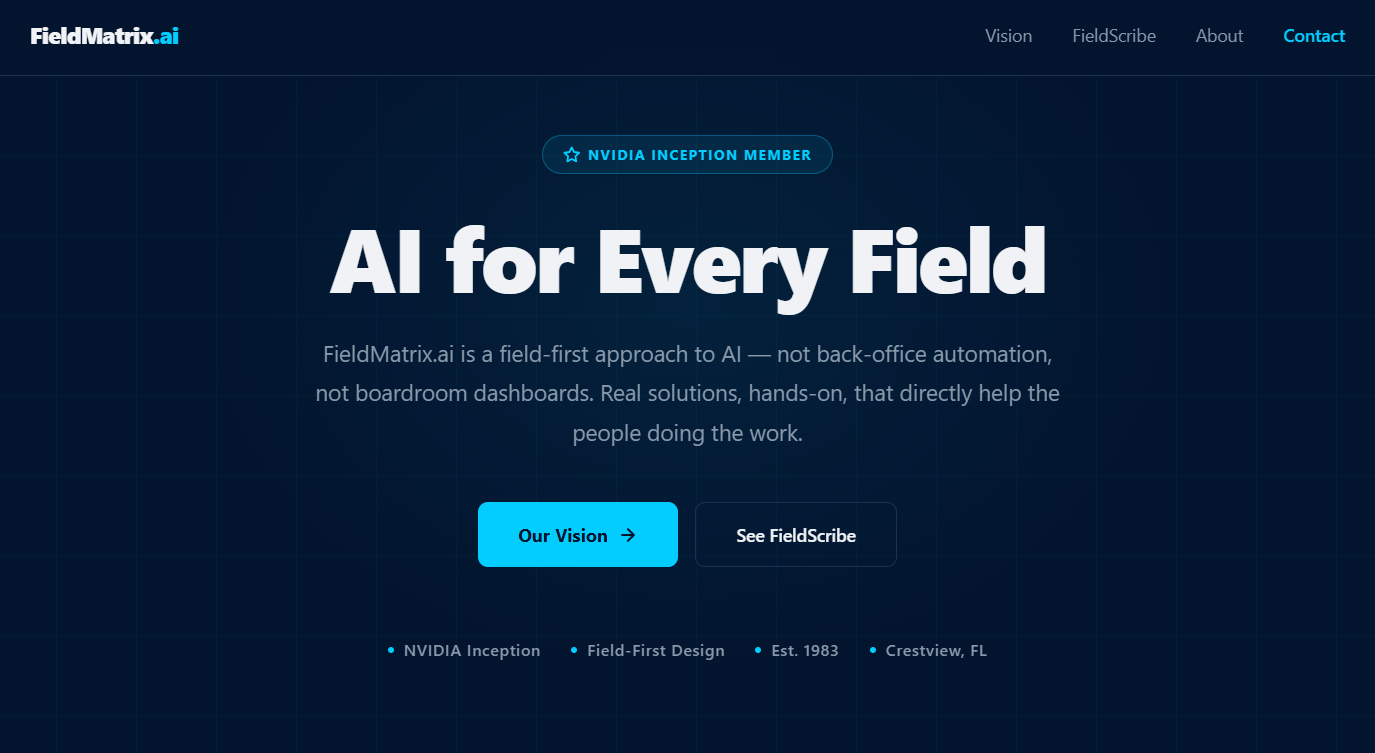
FieldMatrix.AI — AI assistant interface for field service professionals using smart glasses
AI Technology · Field Service AI · Pest Control Industry Infrastructure
Configuration: Advanced GPU VPS — RTX Pro 4000 GPU VPS · 24GB VRAM GDDR7 · 24 Cores · 56GB RAM · 320GB SSD · 500Mbps Unmetered

850 Media is an AI technology company whose product portfolio includes FieldMatrix Operator (a real-time AI voice assistant for field technicians operating smart glasses), SentinelSense (IoT edge sensors), and Termite.Help (a scientific literature extraction engine for pest control research). The company is bootstrapped, funded by a $2M/year pest control business.

The single RTX Pro 4000 GPU VPS sustains a production workload that previously required 3–4 separate cloud services: Ollama running Llama 3.1 70B, Qwen 2.5 Coder 32B, and 12+ additional models for concurrent inference tasks; real-time WebSocket video streaming from smart glasses to the vision AI and back to field technicians; structured extraction across 1,000+ peer-reviewed scientific papers for the Termite.Help research engine; and 24/7 autonomous AI agent pipelines handling research automation and podcast production. The 24GB GDDR7 VRAM in the Blackwell-architecture RTX Pro 4000 provides sufficient headroom for 70B-class models at quantized precision while maintaining availability for concurrent services.

Zero unplanned downtime since deployment 3–4 cloud services consolidated → 1 server 70B+ models running on 24GB VRAM (quantized) 24/7 autonomous agent pipelines
"If you're a small to mid-size AI company that needs real GPU horsepower without enterprise pricing, Database Mart is the move. We're running production AI inference, multiple autonomous agents, and a research pipeline on a single server — and it handles it all."

— Michael G. Cadenhead, Founder, 850 Media / FieldMatrix.AI

Customer Case: The Sovereign Economy

The Sovereign Economy — brand identity for a private AI-powered multi-business empire
Private AI Infrastructure · Multi-Business Ecosystem · 8 Business Verticals
Configuration: Professional GPU VPS — RTX A4000 · 16GB VRAM GDDR6 · 24 Cores · 28GB RAM · 320GB SSD · 300Mbps Unmetered

The Sovereign Economy spans eight business verticals — heritage food, sustainable fashion, legal architecture, community trade, and private estates among them — and is governed by Forbes Command, a private AI infrastructure running 11 AI "C-Suite executives" (autonomous LLM agents modeled after specific executive functions) and 200+ operational bots. The system processes 20,000+ system events continuously, making pattern-recognition-driven decisions across the business ecosystem without human intervention between cycles.

Prior to migration, the infrastructure ran on Groq and xAI APIs. The migration to a dedicated GPU VPS was motivated by three converging factors: elimination of rate-limit-induced service disruptions (API rate limits created unpredictable latency spikes in agentic workflows), removal of third-party data exposure (prompts and business context sent to external APIs transited infrastructure outside the organization's control), and cost predictability (metered API billing was structurally incompatible with the 24/7 continuous inference model). Ollama now serves Qwen3, Llama 3.1, and Mistral-small locally; no inference request leaves the server.

All third-party API dependencies eliminated 11 AI executives + 200+ bots in production Zero data transiting external infrastructure No rate limits on inference
"If you're building serious AI infrastructure and care about data sovereignty, Database Mart's GPU servers are the right foundation. We run an entire AI C-Suite on ours."

— Maggie Forbes, Founder, The Sovereign Economy

Customer Case: Selfomy

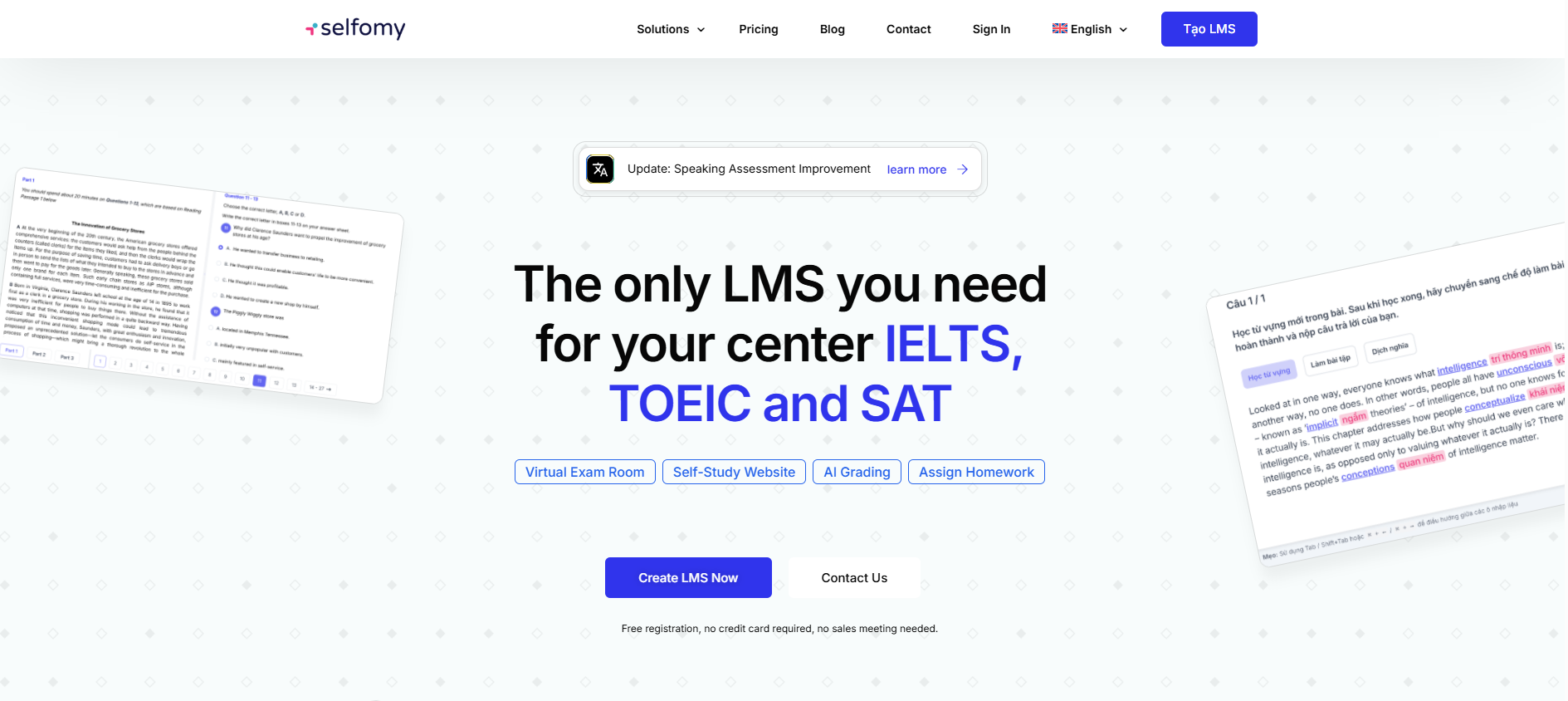
Selfomy AI-powered language assessment platform — IELTS writing and speaking evaluation interface
EdTech · AI Language Assessment · Vietnam / Southeast Asia / United States
Configuration: Professional GPU VPS — RTX Pro 2000 GPU VPS · 16GB VRAM GDDR7 · 16 Cores · 28GB RAM · 240GB SSD · 300Mbps Unmetered

Selfomy was founded in Vietnam in 2013 and received recognition from the Vietnamese Ministry of Education. It operates an AI-powered exam preparation platform for language training institutions, integrating LMS functionality, AI writing assessment, AI speaking evaluation, and student lead generation. The platform serves institutions in Vietnam, Southeast Asia, and the United States.

Monthly throughput on the GPU server: 2,000 PDF documents processed, 30,000 essays scored, and 1,200 hours of speaking audio evaluated. The AI writing assessment pipeline grades IELTS essays across multiple dimensions (task achievement, coherence & cohesion, lexical resource, grammatical range) and returns detailed feedback — median end-to-end latency of 40 seconds, P95 of 74 seconds. Speaking assessment runs Whisper-class ASR followed by pronunciation and fluency scoring models. The Blackwell RTX Pro 2000's 16GB GDDR7 memory provides sufficient capacity for the primary scoring models, with GDDR7 bandwidth enabling faster token throughput than equivalent GDDR6 configurations at the same memory capacity.

~65% cost reduction vs comparable cloud GPU options 40s median essay scoring latency (P95: 74s) 99.99% uptime over deployment period Institution grading time: 50 hrs/wk → 15 hrs/wk (−70%) 18× human grading efficiency at scale
"Dedicated GPU infrastructure at Database Mart's pricing is roughly 65% cheaper than the comparable cloud GPU options we evaluated — which is what makes our business model viable. The unit economics let us serve students at 18 times the efficiency of manual grading."

— Bui Le Chi Bao (Bao), Co-founder & CEO, Selfomy

Customer Case: Gideion Labs

Gideion Labs
Independent AI Studio · Interactive Narrative Engine · Game AI
Configuration: Enterprise Dedicated GPU Server — RTX Pro 6000 GPU VPS · 96GB VRAM GDDR7 · Blackwell Architecture

Gideion Labs is an independent AI development studio building Unseen Worlds — a tabletop role-playing game engine driven entirely by coordinated LLM agents. Multiple AI agents simultaneously occupy the roles of game master, narrator, and every non-player character, generating unscripted narrative responses dynamically based on player actions. Unlike branching-dialogue game AI, this system has no pre-authored content: all output is synthesized at inference time by the agent ensemble.

The RTX Pro 6000 GPU VPS (96GB GDDR7 VRAM) is the minimum viable configuration for the project's quality requirements — at 70B-class full-precision models, lower-VRAM configurations require quantization levels that degrade the narrative coherence the product depends on. Prior infrastructure included a local Texas-based server (disrupted by extreme weather events) and RunPod cloud GPU (disrupted repeatedly by spot-instance preemption mid-inference — a failure mode incompatible with an interactive game session). The migration to a dedicated physical GPU server resolved both failure modes simultaneously.

Spot-instance preemption eliminated Weather-related outages eliminated 96GB VRAM enables 70B+ full-precision inference Project advanced to early user testing
"If you're running serious AI workloads and need infrastructure that stays up without managing cloud pricing volatility or fighting for spot instances, Database Mart is worth the investment. The support team treats you like a long-term partner rather than a ticket number."

— Gideion, Gideion Labs

Customer Case: ZeroOne Beats

ZeroOne Beats 24/7 internet radio and Twitch live stream interface
Internet Radio · 24/7 Live Streaming · Music Content
Configuration: Express Dedicated GPU Server — P1000 · 4GB VRAM GDDR5 · 8-Core Xeon E5-2690 · 32GB RAM · Dual-disk storage · 100Mbps Unmetered

ZeroOne Beats operates a 24/7 internet radio station and Twitch live stream, running fully automated music programming (RadioBoss), live OBS overlay streams with viewer interaction, a premium music app, and the public station website — all from a single dedicated GPU server. The use case is not AI inference: the GPU's function is exclusively NVENC hardware-accelerated H.264/H.265 video encoding for the live stream output. The P1000, despite its modest 4GB VRAM, contains a dedicated NVENC encoder block that processes the real-time encoding workload without consuming any CPU cycles — leaving the 8-core Xeon entirely available for RadioBoss automation, IIS web serving, and JSON status pipeline operations.

The architecture decision reflects a principle that applies beyond streaming: in workloads where GPU function is encoding rather than inference, the correct selection metric is encoder quality and uptime — not VRAM or TFLOPS. A P1000 at $49/month outperforms a cloud-based encoding solution in this context not because it is computationally superior, but because it is physically dedicated, thermally stable at sustained load, and never subject to resource contention from other tenants.

Zero thermal throttle or signal interruptions in 24/7 operation Encoding + automation + web hosting on one server, no contention Local machine fully freed from streaming workload
"If you're running anything that needs a GPU on continuously — live streaming, encoding, automation — Database Mart gives you the dedicated hardware and uptime to actually rely on, without the babysitting."

— Tue Agerbak, Founder, ZeroOne Beats

Customer Case: DePeru.com

Digital Media Platform · News & Business Directory · Peru
Configuration: Basic Dedicated GPU Server — RTX 4060 · 8GB VRAM · 8-Core Xeon E5-2690 · 64GB RAM · Dual-disk storage · 100Mbps Unmetered

DePeru.com is a Peruvian digital media platform covering news, business directories, and industry articles for a broad consumer audience. The GPU server supports local AI model inference integrated into an internal editorial dashboard, where AI processes and organizes large volumes of database-resident content — categorization, summarization, and information extraction tasks that previously required manual editorial effort or external API calls.

The DePeru.com case illustrates a procurement pattern observed across several media and content-platform customers: GPU infrastructure cost that is economically neutral relative to the prior non-GPU hosting solution (because dedicated server pricing with GPU is comparable to equivalent CPU-only dedicated server pricing at scale), while delivering a net new capability — local AI inference — at no marginal cost increase. AI and web workloads coexist on the same physical server without performance interference, enabled by the RTX 4060's ability to serve AI inference requests without saturating the shared CPU and I/O resources that the web platform depends on.

GPU hosting cost ≈ prior non-GPU dedicated server cost AI inference and web workloads coexist without contention <5 min support response time cited as differentiator
"Their pricing is competitive, and most importantly, their technical support is fast and responsive — something that has become increasingly rare among hosting providers today."

— Wilson Cabezas, DePeru.com

Section 6 · Procurement Analysis

Why Enterprises Choose GPU Hosting: Six Structural Drivers

The following drivers are drawn from the six authorized customer cases and corroborated by patterns in the anonymized technical support record analysis. They represent observed decision factors, not survey responses.

DriverMechanismEvidence from Dataset
Infrastructure cost reduction At sustained 24/7 utilization, flat-rate dedicated GPU pricing ($21–$2,099/mo, bandwidth included) structurally undercuts per-token or per-hour cloud API billing. The crossover point varies by GPU class and utilization rate, but is typically reached between 300–600 hours/month of GPU use. Selfomy: ~65% cost reduction vs comparable cloud GPU. DePeru.com: GPU server at parity with prior non-GPU hosting cost. 850 Media: 3–4 cloud services replaced by one server.
Data sovereignty Physical dedicated infrastructure with no shared tenancy is the only architecture that guarantees data never transits third-party systems. This is a compliance requirement in healthcare and financial services, and a competitive-security requirement in trading, legal, and agentic AI contexts. The Sovereign Economy, Gideion Labs: explicit API migration for data control. Healthcare AI case: HIPAA-equivalent requirement. Quantitative trading case: proprietary signal protection.
Elimination of preemption risk Spot and preemptible cloud GPU instances can be terminated mid-inference without warning. For interactive AI applications, agentic pipelines, and 24/7 encoding — where workload continuity is non-negotiable — dedicated physical servers eliminate this failure mode entirely. Gideion Labs: migrated from RunPod after repeated spot-preemption during active inference. ZeroOne Beats: 24/7 encoding cannot tolerate interruption.
Reduced time-to-production Linux GPU instances provision in minutes; Windows in 1–2 hours. For early-stage teams validating AI product assumptions, the elimination of hardware procurement cycles (4–12 weeks for on-premise) is the decisive factor. 850 Media (Bootstrapped): no capital available for hardware. Selfomy: startup needing rapid production deployment before fundraising.
Multi-service consolidation A single GPU VPS can simultaneously run LLM inference, TTS synthesis, video encoding, vector search, and image generation — workloads that previously required separate cloud service subscriptions with individual billing, configuration management, and failure domains. 850 Media: research pipeline + agent + vision AI on one server. ZeroOne Beats: encoding + radio automation + web on one server. Anonymized digital human case: LLM + TTS + memory on one 48GB card.
Scalable infrastructure path GPU VPS → Dedicated GPU Server → Multi-GPU dedicated represent a continuous upgrade path within one provider relationship, allowing infrastructure to scale with workload without migration complexity or provider switching costs. 3D design SaaS customer (anonymized): GT710 Lite → Enterprise Multi-GPU 3×RTX A6000 over multiple years, within GPU Mart.

Section 8 below provides a detailed GPU selection reference by workload type, with current GPU Mart pricing for each configuration.

Section 7 · Deployment Model Analysis

GPU Hosting vs Cloud GPU vs On-Premise: A Structured Comparison

The following comparison is structured around observable decision criteria, not promotional claims. Actual TCO must be calculated per workload, accounting for GPU model, sustained utilization hours, bandwidth, storage, and operations headcount.

DimensionGPU Hosting (Dedicated Physical)Public Cloud GPU (AWS/GCP/Azure)On-Premise GPU
Capital requirement None — monthly OpEx from $21/mo (GPU VPS) · $49/mo (Dedicated). No hardware depreciation. None — metered consumption billing High — $15,000–$50,000+ for enterprise GPU hardware; plus facility, power, cooling
Deployment timeline Linux: minutes. Windows: 1–2 hours. Minutes (H100/A100 frequently unavailable due to demand) 4–12 weeks (procurement, shipping, rack installation, configuration)
Resource exclusivity Physical GPU exclusivity guaranteed. GPU VPS uses KVM PCI Passthrough — no hypervisor overhead on GPU. Dedicated server: full bare metal. Shared or spot (preemptible) by default on most instance types. Dedicated instances available at significant premium. Full physical exclusivity
Operational burden Provider maintains hardware, power, cooling, and physical security. Customer manages OS, software stack, and application layer only. Provider maintains all infrastructure. Customer manages cloud environment, IAM, networking, and service configuration. Full in-house responsibility: hardware, power, cooling, physical security, network, OS, and application layer
Cost structure at scale Flat monthly rate inclusive of bandwidth. Predictable at any utilization level. Cost per GPU-hour decreases with utilization. Metered: compute + separate bandwidth egress + storage IOPS + snapshot charges. Cost scales with utilization; unpredictable at high bandwidth. Fixed depreciation + electricity + cooling + maintenance + personnel. Low per-unit cost at high utilization over long term.
Data privacy architecture Physically dedicated server. Data processed on-machine does not transit any third-party system. SOC-certified US data center. Data transits cloud provider infrastructure. Subject to provider's terms of service and government data access frameworks. Maximum physical data control. No third-party infrastructure involved at any layer.
Workload continuity No preemption. No spot termination. 99.9% Uptime SLA. Physical hardware reserved exclusively for one customer. Spot/preemptible instances subject to termination without notice. On-demand dedicated instances available but expensive and frequently out of stock. Subject to internal hardware failure. Redundancy requires duplicate hardware investment.
Optimal for Persistent inference, 24/7 encoding, batch rendering, data-sensitive workloads, mid-to-high-end GPU, 300+ hours/month utilization Short-burst training, global multi-region low-latency serving, rapid experimentation, workloads under 200–300 hours/month Ultra-long-term fixed loads (5+ years), organizations with mature infrastructure teams, very high sustained GPU density
Not optimal for Very short-term use (<1–2 weeks), global multi-region distribution, massive parallel training clusters (100+ GPUs) Sustained 24/7 workloads at scale (cost rises faster than utilization), data-sovereign workloads, latency-sensitive always-on inference Teams without hardware operations expertise, capital-constrained organizations, workloads with variable resource requirements
Section 8 · GPU Selection Reference

GPU Configuration by Workload Type

Specifications validated against GPU Mart infrastructure. Source: NVIDIA official specs and Self-Hosted LLMs: GPU Selection, Benchmarks, VRAM Requirements & Hosting Guide (May 2026). Current pricing at gpu-mart.com/pricing.

VRAM sizing methodology for LLM workloads: Total VRAM required = (Model parameter count × precision bytes per parameter) + KV cache allocation + 20–30% operational headroom. Example: a 14B parameter model at FP16 (2 bytes/param) requires ~28GB base. Q4_K_M quantization (approximately 0.5 bytes/param) reduces this to ~7–8GB. For multi-service stacking, calculate each service independently and sum. Always apply the 20–30% headroom to the aggregate total, not individual services.

AI Inference & Self-Hosted LLM

RTX Pro series cards are available as GPU VPS configurations (KVM PCI Passthrough). All other configurations below are available as either GPU VPS or Dedicated GPU Server as noted.

Entry · Development

RTX A4000 GPU VPS

$129/mo (VPS) · $209 (Dedicated)
  • VRAM16 GB GDDR6
  • ArchitectureAmpere
  • AI TOPS1,321
7B FP16 · 14B INT4 · Dev / test · Entry production
Production · Blackwell

RTX Pro 4000 GPU VPS

$159/mo
  • VRAM24 GB GDDR7
  • ArchitectureBlackwell
  • PrecisionFP4 / FP8 native
14B FP16 · 27B INT4 · Agentic AI · Multi-service
Scale · Multi-user

RTX Pro 5000 GPU VPS

$269/mo
  • VRAM48 GB GDDR7
  • ArchitectureBlackwell
  • PrecisionFP4 / FP8 native
35B FP16 · LLM+TTS stacking · Digital human backends
High-throughput

RTX 5090 GPU VPS

$399/mo (VPS) · $479 (Dedicated)
  • VRAM32 GB GDDR7
  • ArchitectureBlackwell
  • AI TOPS3,352
High-throughput 7B–35B · Audio AI at 488W TDP
Enterprise · 70B+

RTX Pro 6000 GPU VPS

$479/mo
  • VRAM96 GB GDDR7
  • ArchitectureBlackwell
  • FP161,000 TFLOPS
70B FP16 · Multi-model concurrent · TTRPG narrative AI
Data center

A100-80G Dedicated

$1,559/mo
  • VRAM80 GB HBM2e
  • Mem BW1,935 GB/s
  • FP16312 TFLOPS
40B FP16 · Fine-tuning · High-concurrency production

Non-Inference Workloads

WorkloadRecommended ConfigurationKey Selection RationaleFrom
24/7 live stream NVENC encodingExpress Dedicated — P1000 or T1000Hardware NVENC encoder; dedicated server ensures zero CPU contention and thermal stability at sustained load$49/mo
Multi-channel video transcodingBasic Dedicated — RTX 4060 / RTX A4000Higher concurrent NVENC sessions; more VRAM for buffering large frame batches$90/mo
Remote 3D design workstationRTX Pro 4000 GPU VPS24GB GDDR7 Blackwell; certified Quadro/Studio driver support for CAD/CGI/DCC applications$159/mo
Batch architectural renderingAdvanced Dedicated — RTX A5000 or RTX A600048GB VRAM minimizes scene-size-driven render interrupts; unmetered bandwidth for large output file transfer$175/mo
Large-scene parallel renderingEnterprise Multi-GPU — 3×RTX A6000144GB combined VRAM; NVLink for unified memory pool across cards$899/mo
Industrial / AI audio pipeline at high TDPRTX 5090 Dedicated3,352 AI TOPS; Blackwell architecture sustains 488W+ TDP workloads; 32GB GDDR7 for large audio model batch$479/mo
Section 9 · Buyer FAQ

Common Questions from Enterprise GPU Buyers

What is the functional difference between GPU VPS and Dedicated GPU Server at GPU Mart?
GPU VPS (all RTX Pro series — Pro 2000, Pro 4000, Pro 5000, Pro 6000 — plus RTX 5090 GPU VPS): Runs on a virtualized host using KVM with PCI Passthrough. The GPU is exclusively assigned to one VM — no GPU sharing, no time-slicing. VRAM, encoder, and decoder are fully dedicated. The virtualization layer adds negligible GPU overhead. CPU cores, RAM, and NVMe storage are allocated from the host; configurations are standardized per product. Dedicated GPU Server: A complete physical machine — CPU, RAM, storage, network, and GPU are all exclusively yours with no hypervisor layer above the GPU. Larger CPU core counts and RAM configurations are available. Suited for workloads where raw CPU throughput, maximum local storage, or I/O density matter alongside GPU compute. Both product lines guarantee GPU physical exclusivity. The choice between them is determined by CPU/RAM/storage requirements, not by GPU access quality.
How should I calculate VRAM requirements for a multi-service GPU stack?
Calculate each service independently, then sum with headroom. LLM inference example: Llama 3.1 8B at FP16 = 8B × 2 bytes = 16GB weights; add ~2–4GB KV cache at standard context length. Total: ~18–20GB. At Q4_K_M: ~5GB weights + ~2GB KV cache = 7–8GB. Multi-service stacking example (observed in dataset): Qwen 3.5-35B at AWQ 4-bit (~28GB) + CosyVoice 3 TTS (~10.9GB) = 38.9GB baseline. Apply 20% headroom: ~47GB. This requires a 48GB card minimum (RTX Pro 5000 GPU VPS or RTX A6000). General rule: GPU memory fragmentation and framework overhead consume 10–20% of nominal VRAM in production. Never plan to fill VRAM to capacity — plan to 70–80% maximum sustained allocation. Full methodology: Self-Hosted LLMs: GPU Selection, Benchmarks, VRAM Requirements & Hosting Guide
What data privacy guarantees does GPU Hosting provide, and which regulatory frameworks does it satisfy?
GPU Mart servers are hosted in US SOC-certified data centers. Physical dedicated servers (both GPU VPS and Dedicated GPU Server) assign hardware exclusively to one customer — no other customer's workload runs on the same physical machine. Data processed on your server — model inputs, outputs, intermediate activations, stored files — never transits GPU Mart's internal network to another customer's environment, and does not leave the data center except through your configured network egress. This architecture satisfies the data isolation requirement that underpins HIPAA-compliant healthcare AI, GLBA-adjacent financial data processing, and most enterprise data residency policies. For sectors where regulatory documentation of data handling is required (healthcare contracts, financial audits), GPU Mart's SOC certification and dedicated-hardware architecture provide the auditable infrastructure documentation these frameworks require. Note: regulatory compliance is ultimately the customer's responsibility; GPU Mart provides the technical architecture that enables compliance, not legal certification.
At what utilization level does GPU Hosting become more cost-effective than public cloud GPU?
The crossover point depends on GPU class and cloud provider pricing, but the structural math is consistent: GPU Hosting is a flat monthly cost regardless of utilization, while cloud GPU is metered per hour (plus separate bandwidth, storage, and IOPS charges). At low utilization (under ~200 hours/month), cloud GPU on-demand pricing may be lower in compute cost alone — though bandwidth and storage charges frequently close the gap. At sustained utilization above ~300–400 hours/month (approximately 40–55% of a 30-day month), GPU Hosting's flat rate consistently outperforms equivalent cloud GPU at comparable specs. At 24/7 utilization (720 hours/month), the cost differential measured in the Selfomy case (~65% lower) is typical for mid-tier GPU classes. The comparison must account for bandwidth: GPU Mart's unmetered bandwidth inclusion eliminates a cost category that cloud GPU billing itemizes separately, and which can represent 20–40% of total cloud GPU cost for workloads with significant data movement.
What workloads are structurally unsuitable for GPU Hosting?
Three workload categories are structurally better served by alternatives: (1) Very short-duration burst workloads (under 1–2 weeks): Monthly billing creates poor economics for workloads measured in hours or days. Cloud spot GPU or serverless inference endpoints are more appropriate. (2) Globally distributed low-latency inference: GPU Mart's current infrastructure is US-based. Applications requiring sub-50ms inference latency for users across Europe, Asia, or Latin America need edge inference nodes or regional cloud GPU supplementing any centralized GPU Hosting deployment. (3) Hyperscale parallel training clusters (100+ GPU nodes): This scale requires custom interconnect fabrics (NVLink/InfiniBand at data center scale) and dedicated cluster management that is the domain of hyperscaler GPU clouds, not single-server GPU Hosting. A common hybrid architecture uses GPU Hosting for persistent production inference while using cloud GPU clusters for periodic model training runs.
Final Conclusion

What This Dataset Tells Us About Enterprise GPU Infrastructure in 2026

The 200 records analyzed in this report collectively describe a market in transition — not at its beginning, and not yet at saturation. The technology sector has already crossed the GPU Hosting adoption threshold. Media, financial services, real estate, and professional services are in active adoption. Healthcare, manufacturing, government, logistics, and agriculture are at the frontier — present in the data, but not yet at scale.

Three structural observations stand out from the full dataset:

First: The workload diversity is greater than the industry diversity. The same fundamental infrastructure — a physical dedicated GPU server with a Blackwell or Ampere NVIDIA GPU, running Ollama or vLLM, behind FastAPI or Nginx — appears across AI assistants, legal document analysis, 3D rendering, 24/7 radio streaming, medical record generation, quantitative trading, audio dataset cleaning, and drone-based construction monitoring. The GPU Hosting infrastructure layer is becoming domain-agnostic.
Second: Data sovereignty is the unifying constraint across the highest-value use cases. When enterprises are handling proprietary trading signals, patient medical records, classified client communications, or agentic AI that processes their entire business context, the data cannot leave a physically controlled environment. Dedicated GPU Hosting is the only commercially available infrastructure model that satisfies this requirement at a price point accessible to non-hyperscale organizations.
Third: The upgrade path within GPU Hosting is longer than it appears at first procurement. The dataset contains customers with 75, 137, and 354 package records — multi-year relationships where GPU infrastructure has scaled alongside business growth through multiple product tiers. GPU Hosting is not a temporary bridge to self-hosted infrastructure for these customers; it is the permanent infrastructure layer, scaling continuously as the business requires.

Approximately half the sampled customers were not assigned to a specific scenario — not because their GPU usage is unclear, but because the available business context was insufficient to classify them with confidence. Their workloads remain part of the broader GPU Hosting demand picture and will be incorporated into future editions of this report as more customer context becomes available.

Readers evaluating GPU infrastructure for their own organization can review current GPU VPS and dedicated GPU server configurations directly on GPU Mart's site.

Author: GPU Mart Research Team · Published by Database Mart · June 2026 · This report is published as a living document and will be updated semi-annually as new data becomes available. Next scheduled update: December 2026.

Methodology, Sources & Disclosure

Research Foundation & Data Disclosure

Primary Data Sources

  • GPU Mart (Database Mart's GPU hosting brand) enterprise customer GPU order dataset — 200 records, 197 unique domains, June 2026
  • GPU Mart internal technical support workload records — fully anonymized; no personal data, company names, or domain identifiers retained
  • Authorized customer written interviews — 6 cases (850 Media / FieldMatrix.AI; The Sovereign Economy; Selfomy; Gideion Labs; ZeroOne Beats; DePeru.com); written consent on file for each

Third-Party Sources

Classification Approach

Industry and scenario classification requires both an industry category and supporting business context for a record to be placed in a specific scenario. Where context is insufficient, records are retained as unclassified (~50% of the sample). All scenario percentages are calculated against the full 200-customer sample.

Non-Disclosure Commitments

This report does not disclose: revenue figures, renewal rates, churn data, or financial performance metrics for any customer. Anonymized workload observations contain no company names, domain identifiers, or personal information. Authorized customer cases are published only with explicit written permission. Quoted statements from authorized customers are reproduced verbatim without editorial modification.

Citation

This report may be cited as: "GPU Mart Enterprise GPU Hosting Report 2026, gpu-mart.com, June 2026." For questions about the data or methodology, contact the GPU Mart Research Team via gpu-mart.com, the GPU hosting brand of Database Mart.

Author: GPU Mart Research Team · Published by Database Mart · gpu-mart.com · June 2026 · Keywords: agentic AI · AI compute · AI deployment · AI deployment stack · AI hosting · AI inference infrastructure · AI infrastructure · AI production environment · AI server · AI workload · enterprise AI agents · GPU infrastructure · LLM infrastructure · private AI · self-hosted AI · GPU hosting · GPU dedicated server · GPU VPS · GPU server IaaS